Structural Armor and Institutional Provenance: The Materiality of Industrial FRP
- 中村 有一|YUICHI NAKAMURA

- 5月22日
- 読了時間: 2分
I. Industrial FRP: Material Necessity and Existential Substrate

The physical substrate of this artistic practice utilizes industrial FRP (Fiber Reinforced Plastics) and hazardous industrial polyester resin, strictly bypassing standard commercial art mediums. This choice is rooted in the existential memory of a former career in professional racing—where the high-velocity cockpit functioned as a structural armor for survival at the threshold of life and death.
By embedding the fragile illusion of photographic light within this volatile, high-shrinkage material, the plane is chemically encapsulated and buried. The deliberate manipulation of glass fiber density and the trapping of micro-air bubbles control the molecular surface, freezing the fluid chaos of reality within a rigid mechanical matrix.
II. Institutional Provenance and Lineage



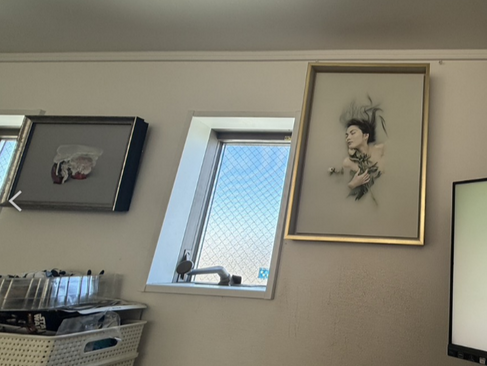
This evolutionary shift toward spatial deconstruction and multi-layered chemical coating is conceptually aligned with the practice of contemporary artist Misuzu Shibuya, who structurally dismantles the flatness of images through traditional and mixed-media approaches.
As an objective verification of primary market value, institutional validation, and historical continuity, this private collection actively holds her representative work. The physical and conceptual provenance is archived globally via the international art index, Artsy:
Artist Registry:View Misuzu Shibuya on Artsy
Acquired Artwork:The Apple number 02 (Private Collection)
Conceptual Influence: [Shaman] / iCON 2023
III. The Logic of Continuous Refinement
The current pursuit of rigorous mechanical polishing and flawless multi-layer chemical execution stands as a direct response to institutional critique. Rejecting the initial, structurally unrefined objects of the early studio phase—which were rightfully dismissed under rigorous fine-art standards as mere industrial waste—this practice committed to absolute material control. The resulting works exist not as decorative imagery, but as institutional critiques of durability, memory, and physical presence.